Saturday, March 14, 2015

Cambodia: Phnom Penh

We left for Phnom Penh (pronounce the “ph” as a “p”! It’s not an “f”, and the “ph” ain’t silent either) by bus from Siem Reap after our second full day at Angkor Wat, arriving late that afternoon. We were tired from the bus ride, but didn’t want to completely waste a full day, so we headed out to the most western friendly area of Phnom Penh called Sisowath Quay, or more commonly known as “Riverside” (Phnom Penh is situated in the middle of Cambodia, where the Tonle Sap feeds into the Mekong.). It’s about what it sounds like; restaurants, shops, and parks down by the side of the…river.

Ahhhh...spacious leg room on a 6 hour bus.

It should be stated now that Phnom Penh is chaos. Maybe it’s the traffic, or our skewed perception heading into it (unsolicited warnings about muggings were given to us multiple times), but Phnom Penh brought a new level of overwhelmed senses. We’d also been told that Phnom Penh is like what Bangkok was 30 years ago, and it was easy to see why. Take Bangkok, remove the high rises, the public metro system, a visible security force, and any pretense of obeying any of the few traffic laws and lights, and you have yourself a Phnom Penh. Needless to say we were always a little more on guard, and never stayed out much past dark.

We had dinner and took a stroll on Riverside. There was a DQ, and if you see a DQ in Cambodia you’re obligated to go. I can verify that even in SE Asia they have to turn your Blizzard upside down before they hand it to you.
The King gets a billboard outside the Royal Palace, just in case anyone forgets who lives there.
  
The next day had been set aside as a day where we each went our own way. Christy had the opportunity to visit with a (I say “a”, but it might actually be “the only”) speech pathologist doing NGO work in Phnom Penh, so I was on my own.  Here's Christy's account:

I met up with Elizabeth Chafcouloff, an SLP from the US who started Speech Therapy Cambodia (speechie friends, check out her Facebook page!). She is currently working with two hospitals in Phnom Penh and is training their neurology students about speech, language, cognitive and swallowing evaluation and remediation. It was so cool to see how excited they were about expanding their knowledge base and including the tenants of speech, language, and swallowing in their assessment and treatment of patients. Cambodia (the whole country) currently has no speech therapists or a speech therapy education program. Elizabeth is working to add some curriculum to the training program for doctors as well as physical therapists. I don't have any pictures because I thought I would be able to return the next day when they were doing FEEs training, but I got sick. Overall, I am so thankful for the short but wonderful experience and I hope to meet up with Elizabeth again!

I went for a workout at the only Crossfit gym in Cambodia, Crossfit Amatak. While I was a bit rusty and awoke the next few days to soreness, it was a needed change from our usual travel workout of running, situps, burpees, and/or jump rope. The gym was very welcoming, and they even had a (mostly) paleo café attached, which provided a respite from rice and noodle dishes.

Sorry no workout pics, so here's one of their lattés.

Christy and I met back up later that afternoon, but since Christy had begun to feel sick, we stayed in for the rest of the day. The next day, with Christy still not feeling well, I stayed in that morning until Christy started feeling ok enough to be by herself. NOTE: I did not abandon my wife in the city that I just described as chaotic. I made sure that she was taken care of before I left to go see more of Phnom Penh.

One of the subjects I wanted to make sure we covered while in Cambodia was the Cambodian genocide. I’d heard of the Khmer Rouge and Pol Pot, but I didn’t actually know anything about what happened, and in my experience I don’t think many Americans do. Unlike the Holocaust, which is on our TV, in our movies, and taught in our history classes, knowledge of the Cambodian genocide generally remains limited to the aforementioned Pol Pot. That’s not to compare the two; it’s genocide. But I do think it’s a shame that we don’t acknowledge what happened in Cambodia less than half a century ago. Go here and spend 5-10 minutes reading more, but in short, between 1975 and 1979 the Khmer Rouge tortured and/or executed up to 3 million Cambodians, and at least 25% of the total population. For comparison, that would be about 80 million Americans murdered in over 5 years.

 My afternoon was spent at Tuol Sleng, also known as S21, which was a secret prison the Khmer Rouge sent perceived enemies for torture and almost certain execution. It is not a pleasant experience. It’s mostly an empty complex filled with only pictures of the horrors left behind when the Vietnamese threw the Khmer Rouge out of Phnom Penh.

 This was most of the exhibit at Tuol Sleng, rows of pictures of victims. Women and children of the accused were also killed to prevent retribution.

 The next day, with Christy feeling well enough to head out, we went to Choeung EK. Of all of the notorious “killing fields” that were used during the Cambodia genocide, Choeung Ek is the closest to Phnom Penh and as such has been set up as the de facto memorial site for all of the genocide victims. Most of the S21 victims were brought here for execution. Again, another profoundly sad place to visit. Some remains were excavated and had been placed in a memorial stupa, and more remained in their makeshift graves. The most jarring moments came about from seeing remains that were exposed, either on or just off the dirt walking path. Memorial staff placed warning/do not disturb signs in these locations, but it seems they had run out of enough signs to place as some exposed remains had no such signage. Apparently this problem is exacerbated during the rainy season.

The Memorial Stupa. At the bottom of the pic you can see some of the earth that has sunk where the graves were.

That afternoon Christy took the rest of the day off to finish her recovery. I decided to go out and see what was left of Phnom Penh before we had to leave the next day. First stop was the currency exchange so we could have some cash when we landed in India, and then a search for KFC. Most people experience hunger for comfort foods when they’ve been traveling awhile. From experience, I can say that when you’re sick that feeling magnifies. My wife wanted mashed potatoes and gravy, and we figured the ubiquitous KFC would have it if anyone did. Sadly, Google maps is rather unreliable in SE Asia and KFC was nowhere to be found by our hotel. I then proceeded to do something my parents would not be happy with; I took a motortaxi (motorcycle + taxi). Yea, no helmet and in that traffic, but I was tired of waiting to find a tuk tuk and I needed to get to the Royal Palace before it closed. Well I made it in one piece, though I’m pretty sure I white knuckled it the whole way. If that’s the craziest thing I do while traveling then I’d say Mom and Dad can rest easy. The Royal Palace was fairly similar to the Grand Palace in Bangkok, with coronation halls and residences and chedis and temples. Cambodia even has their own Emerald Buddha, though it is not as impressive as its Thai counterpart. The most unique site of the Royal Palace was the Silver Pagoda (which housed the aforementioned Emerald Buddha), named for the silver tiles that line its floors.

 
Coronation Hall Selfie.
Pictures aren't "technically" allowed in the Silver Pagoda but that's so you don't photo the Emerald Buddha. These are the silver tiles.

After that I proceeded to Wat Phnom, a 12th century Buddhist temple located in the heart of Phnom Penh. It happened to be Chinese New Year, and although Phnom Penh’s Chinese population isn’t near as large as other SE Asian cities, it’s still substantial enough to turn Wat Phnom into a bustling hive of local ethinc Chinese offering prayers for the coming year.

 
Looking down from Wat Phnom. I didn't intentionally want a picture of the beggars on the staircase, but they were there and plenty in number, likely because of the CNY.
 

Lots of alms for the Buddha.
 

The best thing about Wat Phnom? It was about 200m (everything in my mind is in meters and Celsius by now) away from a KFC. I valiantly returned to the hotel with mashed potatoes, gravy, and French fries. Next stop, India.

Thursday, March 5, 2015

Cambodia: Siem Reap

Getting into Cambodia has been our most interesting border crossing yet. Where previously we have either had a bus which took us all the way through or we have crossed via plane, this particular crossing did not have the former as an option and the latter, well, that would have just been silly. So, we did as was recommend by the online people-who-have-gone-before and started the journey on a bus from Bangkok. Then, we got off the bus about a quarter of a mile from the border. Due to relations between the two countries, crossing all the way through is not an option. After walking through (the official crossing) we had to buy (provide bribes for) our visas. After the official crossing part is important as several swindlers try to trick you into buying (and paying way more for) a visa before the official stop. After the visas, we had to wait in another line to get fingerprinted, photoed and finally stamped. Then, people try to get you to get on the 'free' bus where they take you to another much more expensive bus to go the hour into Siem Reap. On the first bus, we had met a couple from Switzerland who had also read the advice to take a taxi at this point. So, we all joined up and shared a taxi into the city. Unfortunately, once we entered the city we were again confronted by touts. Our taxi stopped and several tuk-tuk drivers tried to get us out of the taxi and to ride with them to our hotels because "the taxi driver didn't know where the hotels were." We all knew this wasn't true and stuck together in our refusal to leave the taxi until we were at our destination. It worked and we successfully avoided an obvious swindle! It's good to have teamwork when confronted with these issues.

Our first stop in Cambodia was Siem Reap. This is the main city/hub for the primary tourist attraction in Cambodia: the ancient ruins of Angkor Wat from the Khmer empire dating from the 9th to the 13th century. This is a huge complex of Hindu and Buddhist palaces and temples. There are around 20 temples total in the 400 square kilometer archaeological park. Most of the temples we toured were constructed by Jayavarman VII and were intended to be Buddhist temples (the temples prior to these were constructed as Hindu). However, after his rule, Jayavarman VIII converted the city back to Hinduism. As such, all of the faces of Buddha were removed or altered to represent Hindu gods. Literally, there were no Buddha heads anywhere. All of the faces were either removed or altered. It was crazy and we kept trying to catch one that they missed. They didn't miss any.

Angkor Wat:
We'll start with the big kahuna. This temple is next to Angkor Thom, the city discussed below. Angkor Wat was built by Jayavarman II and is considered an excellent example of not only Khmer architecture but Hindu symbolism as well. The temple is believed to have been constructed to venerate Lord Vishnu, act as a mausoleum for the king, and is designed to be a replica of the holy Hindu mountain where the god Shiva lives.

Walking up to the front gate of the temple. There are smaller buildings to the left and the right here which are meant to signify Earth. Prior to that there were two similar ones which represented hell.

In front of one of the side entrances. You can see the end of the ballistrade to the right of us is the head of the serpent naga. The majority of ballistrades in Angkor Wat are naga carvings.  

The whole façade with a pond reflection.

One of the 5 main prasads.

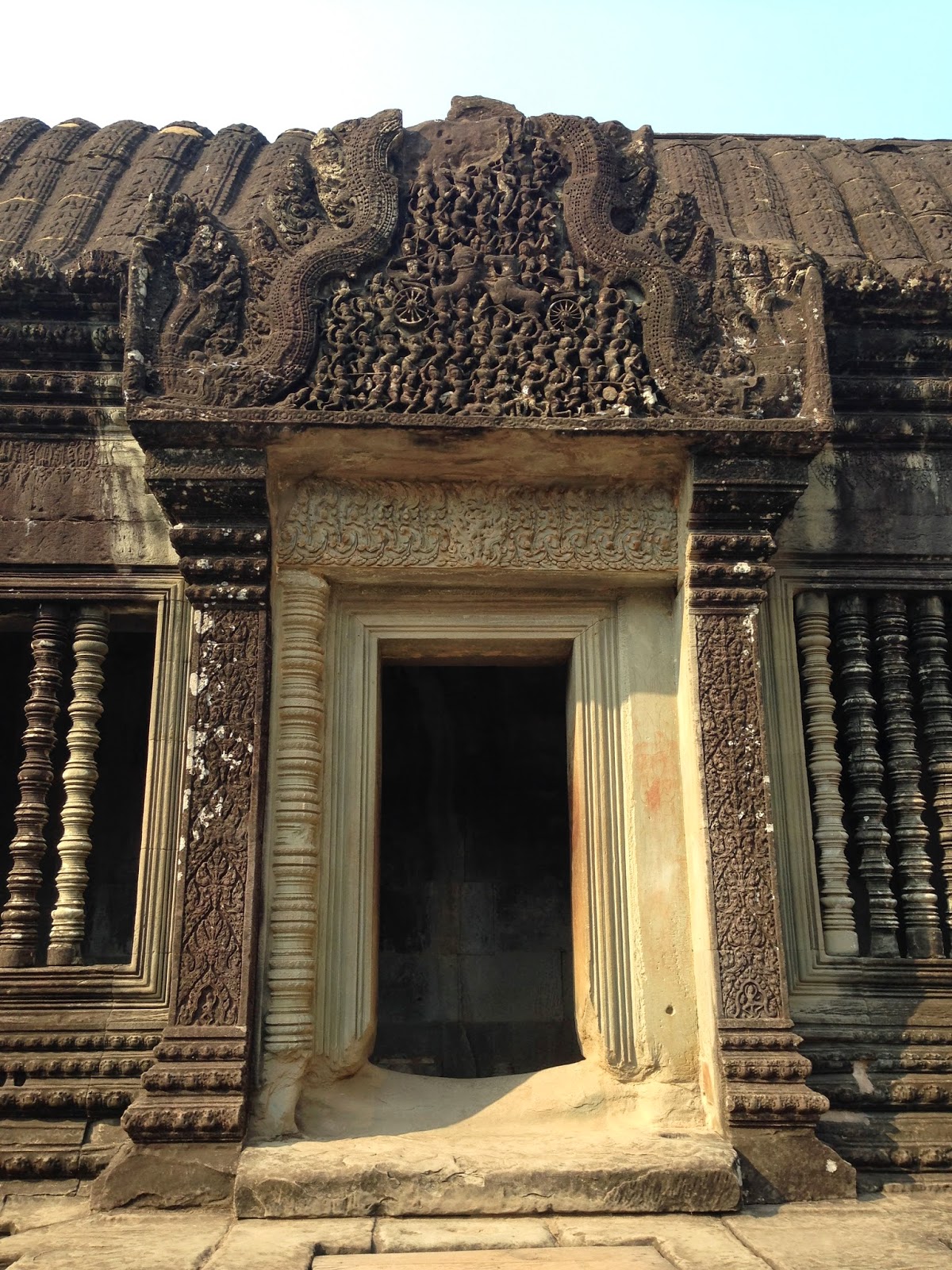
Door with decorated jamb.

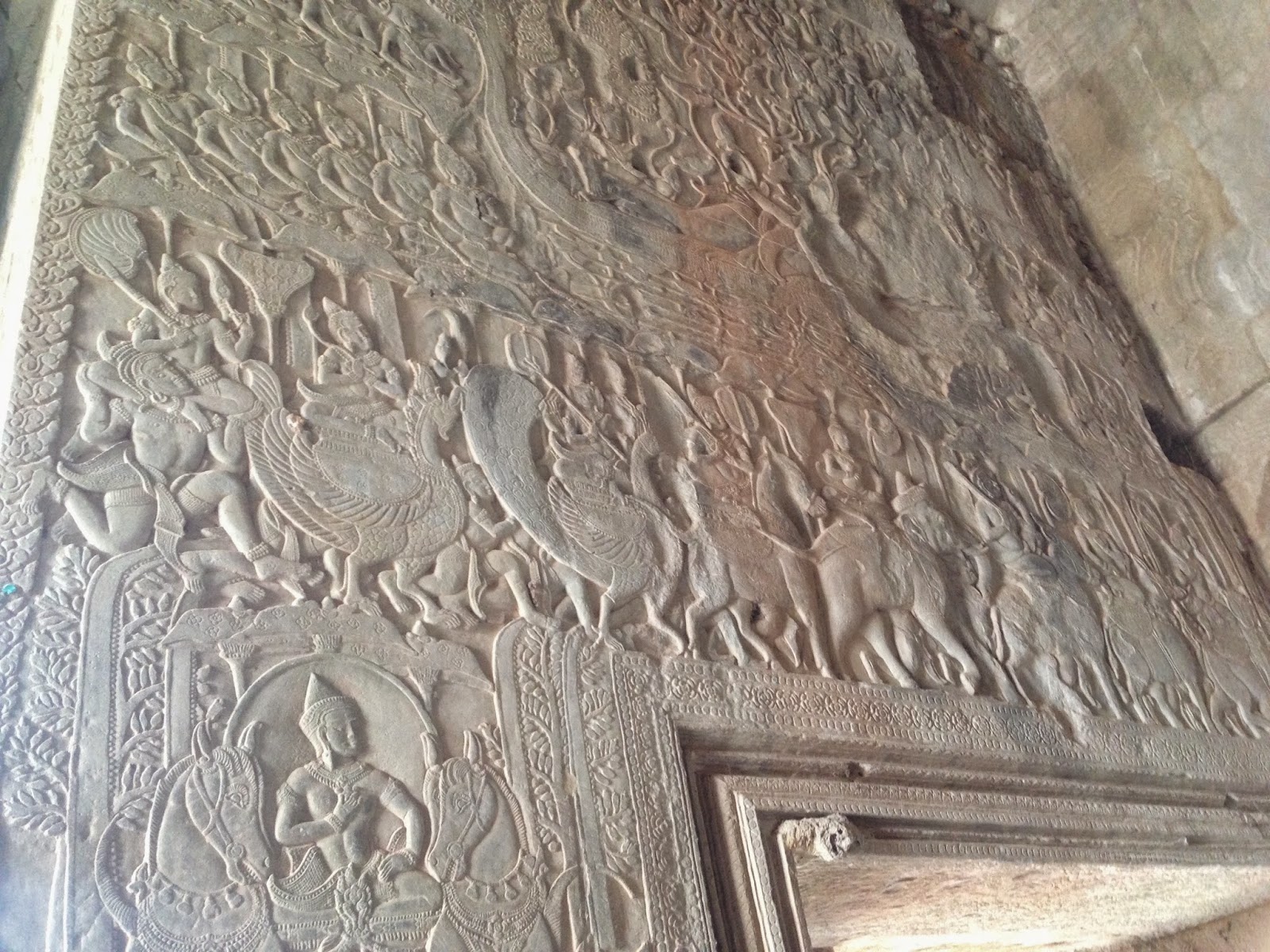
This is just a small portion of the amazingly intricate carvings in the wall which tell parts of the Hindu mythology.

A battle scene. It was difficult for me (iPhone photographer) to capture just how impressive these etchings are.


Angkor Thom:
Angkor Thom means "great city" and was constructed as the capital of Jayavarman VII's empire. There is a high wall and a moat surrounding the 9 square kilometers of the city.


The South entrance gate to Angkor Thom
 
 
Jayavarman VII used a portrait of his face and the Buddha's combined looking in all four directions at the entrance gates.
 
This is not the gate but a close up of the stone faces. These are on towers which were erected to reflect the different 'states' of the empire. Depending on the state of the state the faces are either smiling or look more ambivalent.


This is a three headed elephant which appears on either side of the gate.

Prasat Bayon. This is the temple which uses the faces as described above.


Jared at the middle level of one of the temples.
 
Our guide suggested this fun picture of us leaning on the pillars.

A Buddha carving which was modified to a Hindu theme. Notice the added beard and the beginnings to change the position of the legs from crossed to raised.
 

Carvings of the Uppsidaras (the concubines of the King)
 
 
If I were to continue to post as many pictures as I have above for the rest of the monuments/temples we visited, this would be a giant post and would most likely get a bit redundant. As such, I am going to post a few from each place and skip the introductions/discussions. If we ever return to Angkor Wat, I believe we have agreed to get a week pass and really take time at each place to look at and understand the architecture and the symbolism. It really is an impressive place and one should allow enough time to ponder the themes and understand the architectural symbolism.


Pre Rup

Jared loves animal guardians, especially elephant ones.

Another tower from Pre Rup

This detailed entry is from Banteay Srei, a temple known for the detailed carving and the red color of the rock.
 

Banteay Srei is super impressive and well-restored

Ta Som

I couldn't resist this napping kitty.

Neak Poan, a temple surrounded by manmade lakes and walkways. If/when it gets restored to what the initial structure looked like it will be unbelievable.

 
Ta Prohm. This temple has had some damage from these crazy awesome trees (called Spung trees), but most of the destruction was caused by invading forces riding elephants.

 
Ta Prohm is where Tomb Raider was filmed (at least parts) it is now on our watch list as well!
 
 
Our last picture is unfortunately the only one we have of our awesome tuk-tuk driver, Samnang. He drove us around both days and after the last day invited us to come hang out with his family and friends and have some fish and beer. He was a great guy and we wish all drivers could be more like him!
 
He also had the only tuk-tuk with a t.v. Balla.
 
We really enjoyed our time in Siam Reap and it is definitely on our 'will return' list! So far, it would be the highest on the 'we recommend everyone to see' list as well. Our next stop was Phnom Penh and Jared is writing that post because I, unfortunately, came down with more stomach issues on day two in the city.


Tuesday, February 17, 2015

Thailand: Bangkok

The theme song for Bangkok was set to "Walkin' in Memphis" but of course Memphis was substituted with Bangkok. "I'm walkin' in Bangkok with my feet 10 feet off of SiLom..." it really was playing in the background of my thoughts pretty much constantly. Oh, and of course we took the Midnight Train to Georgia (Bangkok) from Surat Thani and arrived early in the morning. Bangkok was a very melodious stop. I'm not going to document Bangkok day by day since, we lost a day due to being sick (my turn) and had other tedious, uninteresting things (getting a visa for Vietnam, laundry, groceries, cooking) to do. It makes more sense to discuss and provide pictures of the places and events rather than provide a daily chronicle of our time.

In Bangkok we visited the following Wats (temples):

Wat Pho:

 
The size of the reclining Buddha is impressive

The statue is 15 m high and 43 m long

Along the corridor there are 108 bowls meant to represent the 108 characters of Buddha. Visitors drop a coin in each bowl for good luck.

The site of the reclining Buddha is also believed to be the first University in Thailand and where Thai massage originated.

These Buddha statues line the hallways and are representative of a display we saw reoccur in several other temples and monasteries.
 
 
Wat Arun:
 
This temple was under restoration, but is unique in its own way.

 
One of the spires without construction

Not super flattering but a picture at the entrance
 
 
Wat Saket (The Golden Mount):
 
A tiny, golden replica

Happy Buddha in a waterfall. This Wat had several steps and was surrounded by lush greenery. The climb was interrupted by platforms which contained bells and gongs to ring (Jared loudly obliged).

 It was simply stunning as the sun set.

On the way down, I caught this monk letting a dog have a drink from one of the little ponds.
 
 Ayutthaya:
Ayutthaya is considered the second ancient Siamese capital in Thailand. It was founded in 1350 and was destroyed in 1767 by the invading Burmese. It was at that time that Bangkok was established as the capital of Thailand. Anyway, it was very cool to see the ruins and the audio tours began to give us a context for understanding Angkor Wat. Unfortunately, I don't remember the names of all the places we saw. But here are the pictures and some commentary:
Jared climbed to the top, I stayed down below.

This Buddha in the Bodhi tree at Wat Maha That was very cool to see and quite unique. It is a Bodhi tree that has grown around a Buddha image.

There were signs about respecting the Buddha during picture taking (do not straddle the Buddha, etc.) which is a sad commentary on the level of respect paid to these religious sites by tourists.

A Buddha and small prasat (temple)

The sizes of some of the Buddha statues, carved from stone, are so impressive.

On the steps up to the central prasat

This is Wat Phra Sri Sanphet, one of the larger (and probably most iconic) sites in Ayutthaya. It has three large chedis still relatively intact which house the remains of three Siamese kings.

A smaller, all stone reclining Buddha


Wat Chaiwatthanaram

Jared was starting to feel tired after our day of Wat trekking.
 
Grand Palace:
The Grand Palace in Bangkok is a marvelous complex, and it is easy to see why it is held in high esteem by the Thais. The Emerald Buddha is housed here and is considered the most revered image of Buddha in Thailand. Pictures are not allowed of this Buddha.


The hermit doctor at the entrance to the grounds. He is believed to be the originator of Thai herbal medicine.

Gold is, obviously, a common color choice for decoration.

Intricate detail.

Many of the temples and auxiliary buildings are closed to tourists, but the exteriors are still stunning.

A golden guardian

A stupa...also gold.

This picture is of the many tourists that lined up to take pictures with the Thai Royal guard. They're not quite as rigid as their British counterparts but close.

The temple which houses the Emerald Buddha
 
We also saw some Muay Thai boxing, went to the weekend market and took our first boat taxi. Overall, Bangkok was a nice, clean city with excellent options of public transportation (although some of the tuk-tuk drivers can be sneaky) which has some beautiful, cultural sites. I think 6 days was plenty of time and we both were ready for a change of scenery. Next up, we visited the Cambodian city of Siem Reap and explored the breath taking ruins of Angkor Wat!